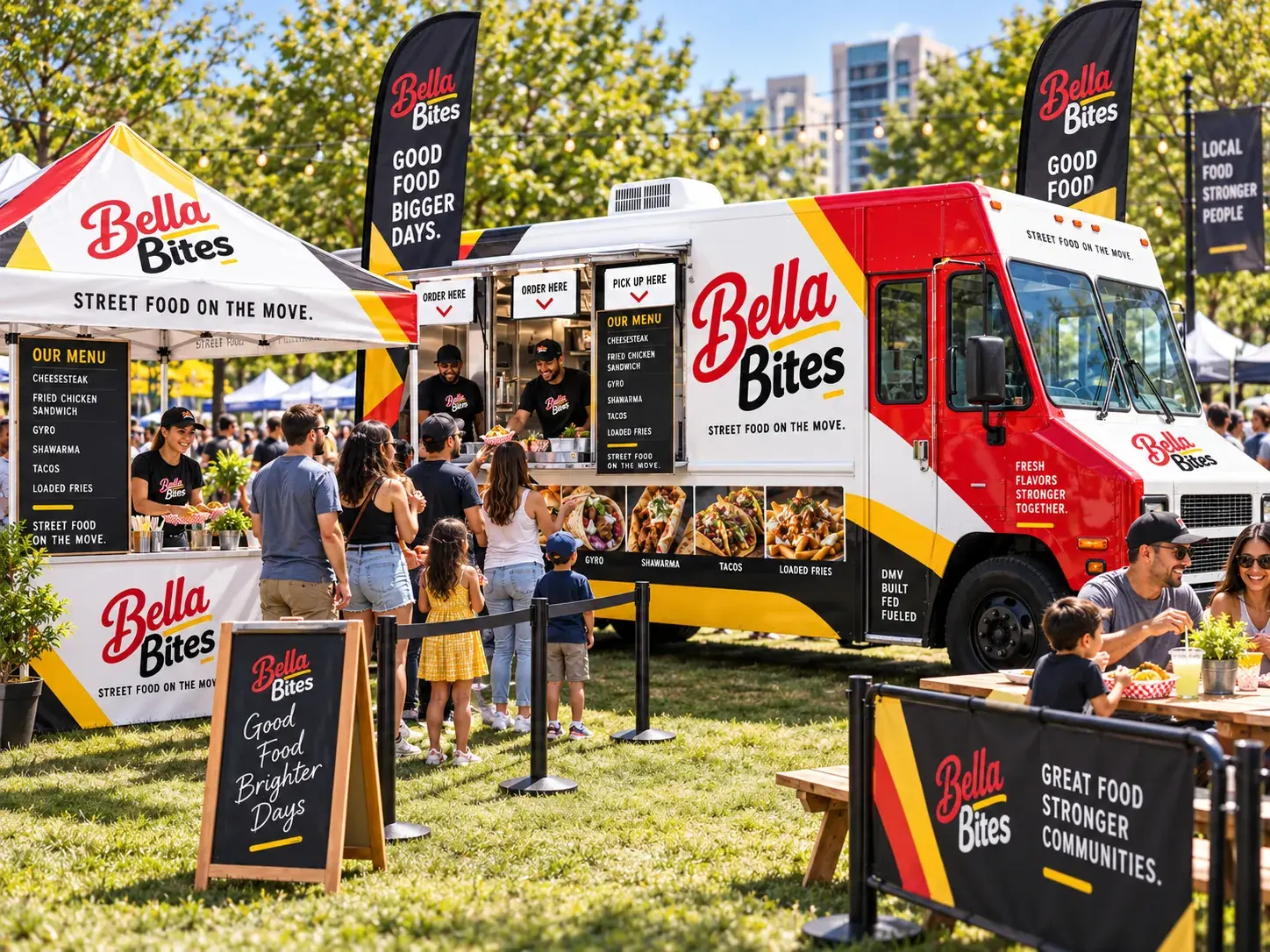
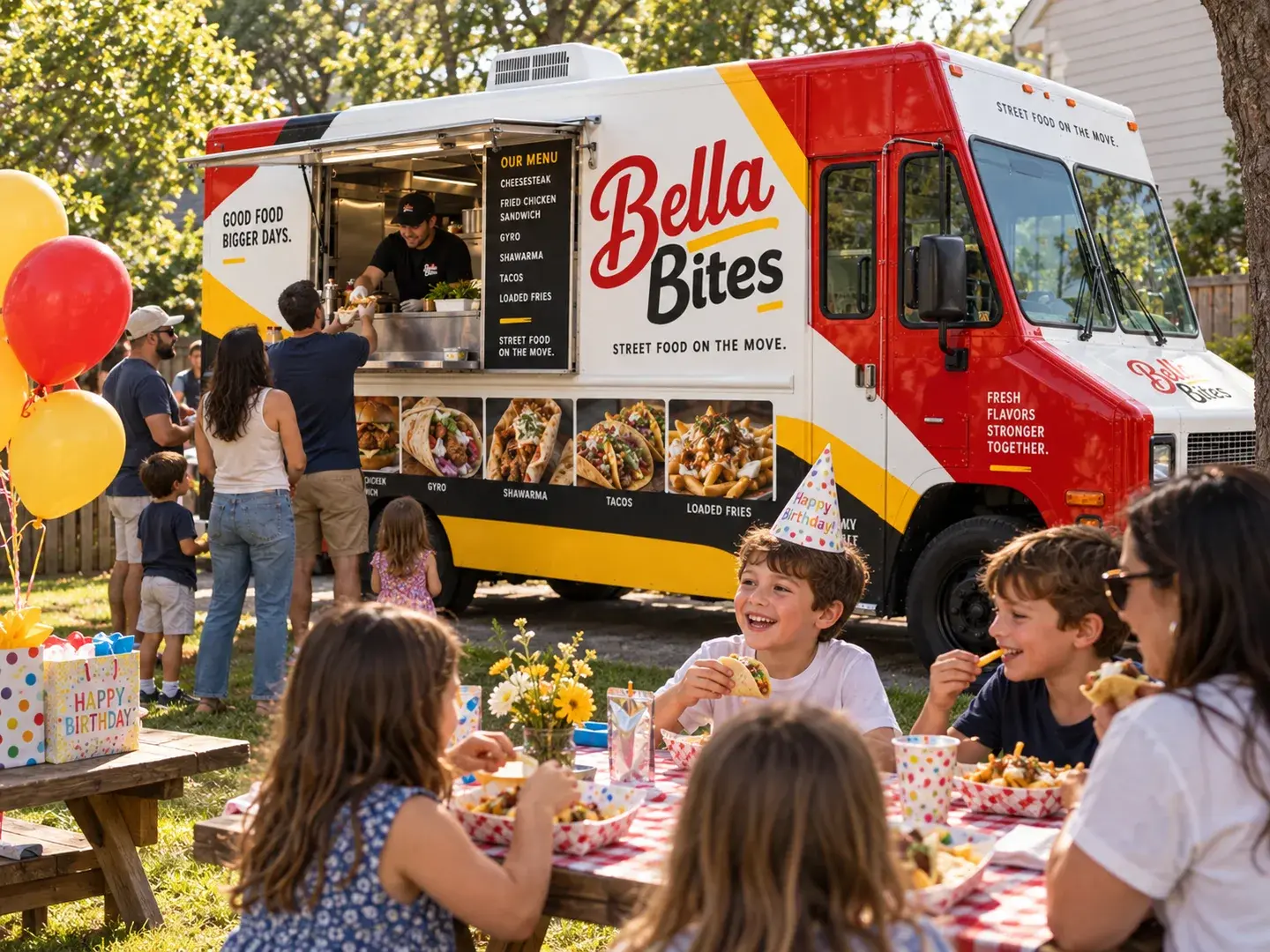
Plan for a level spot about the size of two parked cars, which the truck can drive into forward, plus room beside the serving window for a line. That is the planning number we give for our own truck, and we confirm the exact spot with every host.
The details depend on where you are. A wide, flat office lot is easy. A steep driveway under an old oak is a puzzle. Below we go through each kind of spot, what goes wrong there, and what to measure.
Three things every spot needs
Wherever the truck parks, the same three conditions apply.
- A way in. The truck needs a clear path from the street with no tight turns, low branches, wires or narrow gates.
- A level stand. Fryers and grills hold hot oil and need the truck close to level. A gentle grade can work; a real slope often cannot.
- Room around it. Space for the line, space for the crew to step out, and clearance from anything that can burn.
On that third point, the NFPA food truck safety sheet lists at least 10 feet of clearance from buildings, structures, vehicles and combustible materials, unless the local fire official sets a different distance. It also asks that fire lanes and access to fire hydrants stay clear (NFPA fact sheet (opens in a new tab)).
Driveways
Driveways are the most common spot for home parties and the most common source of surprises. Measure the width at the narrowest point, usually between a mailbox and a hedge. Look up for branches and the cable line that runs from the pole to the house.
Check the surface too. Concrete and asphalt are fine. Pavers, gravel and soft edges are worth a mention, especially after rain. A heavy truck on wet lawn will leave ruts and may get stuck.
Then stand at the bottom and look up. If the driveway climbs steeply toward the garage, the truck may serve better from the street side, with the window facing the yard.
Streets and cul-de-sacs
A cul-de-sac makes a lovely party spot because the line forms on the pavement and nobody has to cross traffic. Whether the truck can park on the street depends on who owns the road and what your locality allows. Some neighborhood streets belong to the county or state; others are private and controlled by the HOA.
If the truck sits curbside, the serving window should face the sidewalk or yard side, never the traffic lane. Ask the operator which side their window is on before you pick a curb.
HOA common areas
Community pool lots, clubhouse lots and private community streets are the HOA’s call. Virginia law lets an association board write rules for its shared spaces (Code of Virginia § 55.1-1819 (opens in a new tab)), and communities in Maryland and DC answer to their own statutes and bylaws. Covenants in some neighborhoods also restrict commercial activity on individual lots. Our guide for apartments and HOAs goes further. Read your community’s rules or ask the management company before the invitations go out.
Property managers have their own checklist for this, which we cover in hosting food trucks at an apartment community or HOA.
Office lots and parking garages
Surface lots are usually the easiest site of all. Pick a corner away from the drive aisle, block off the spaces the night before, and keep the line on the walkway side.
Garages are another story. Most have a posted clearance bar at the entrance, and food trucks are tall vehicles with roof vents and equipment on top. Ask your operator for the truck’s height and compare it with the posted clearance before you plan a garage level. A top deck open to the sky can work if the ramps allow it. Lower levels rarely do, because of height and exhaust.
Engine-driven generators also matter. The NFPA sheet asks that generator exhaust stay at least 12 feet from openings, air intakes and exits, and point away from buildings (NFPA fact sheet (opens in a new tab)). Keep that in mind near lobby doors and loading docks.
Slopes
Slope is the hardest thing to judge by eye. A quick trick: set a ball or a water bottle on the pavement where the truck would sit and see if it rolls. If it takes off, send a photo taken from the side so the operator can judge.
Trucks can level a small amount with blocks. Beyond that, find a flatter spot even if it is farther from the party. Guests will walk an extra 30 feet for food.
Where the line goes
Hosts often plan the truck and forget the line. Picture 20 people waiting at once, and give them somewhere safe and pleasant to stand: off the road, away from the generator side, ideally with some shade in summer. Put trash cans near the end of the line and a small table for napkins and sauces if you can.
Power, water and noise
Most food trucks bring their own power, from an onboard generator or a battery system, and cook with propane. You usually do not need to run an extension cord from the house. Ask anyway, because some operators prefer a quiet hookup when the site has a suitable outlet, and some venues ban generators after a certain hour.
Generators make noise. In a cul-de-sac with neighbors close by, put the generator side of the truck away from patios and bedroom windows. The NFPA sheet also asks that engine-driven power sources be separated from the public by barriers or guards (NFPA fact sheet (opens in a new tab)), so do not plan the kids’ table right next to it.
Water is rarely the host’s job. Trucks carry their own fresh and waste water tanks for handwashing and cleaning, and a responsible operator takes the waste water away with them.
Rain, snow and soft ground
Weather changes the answer for the same spot. A lawn that holds a truck in August can swallow a wheel after two days of April rain. If your plan involves any grass, pick a paved backup spot too.
In winter, check the approach for ice and for the snow piles a plow leaves behind, which can shrink a cul-de-sac by a car width. Think about the line as well: guests waiting in cold or rain need somewhere to stand that is not a puddle. A pop-up tent near the window keeps the line dry.
A five-minute site check
Do this a week or two before the date, and send the results to your operator.
- Photo of the spot from the street, showing the approach.
- Photo from the side, to show the slope.
- Narrowest width on the way in, and anything overhead.
- The surface: concrete, asphalt, pavers, gravel or grass.
- Where the line would stand, and how far that is from the truck’s window.
- For garages: the posted clearance height.
Sources
We link the pages we relied on so you can check them yourself. Rules and permits change, so confirm anything local with the office that issues them.